Hello my wonderful students & families!
A couple of reminders
* Bring permission slips to school tomorrow!
* Spelling test Friday
* Book orders due Friday
Today we learned about adding fractions with different units (denominators). I took a couple photos of the steps in solving these problems. I am confident that everyone will do well tonight! But... just in case!
See you tomorrow!
Mrs. C
Welcome Families! I have created this blog to post updates, information, questions, and homework tips for the families of my students. I enjoy each and every one of your students and am 100% committed to making this year amazing for all of us (you included)! Please continue to email or call for any questions or concerns you may have. I hope this blog is helpful to you all. Mrs. C
Wednesday, January 21, 2015
Wednesday, January 14, 2015
Wednesday January 14th
Happy Wednesday!
Today in math, we started learning about fractions. We are learning how to place fractions on a number line and also create a picture showing fractions.
Number 1.
First we are going to place numbers and fractions on the number line. We are working with 1/3. If you count by 1/3 to 1, we can easily fill in our number line. Start with 0 and 0/3. Our next line would be 1/3, followed by 2/3 and finally 3/3 which is the same as 1.
Now we get to our drawing. For our first box, they have written the fractions below (what a big help right!?)
We are going to start out by drawing two vertical lines in EVERY box. This will break each box into thirds. Since we are working with 1/3, we shade in one third (one rectangle) inside each box.
Now, what we are doing is finding fractions equivalent to 1/3. For the first box, they already gave us the answer... 2/6. However, we still need to fill in the box. We know that they placed on horizontal line in the box, essentially making 2 copies of 1/3. Because of this we are multiplying the 1 and the 3 in 1/3 times 2. This gives us 1 x 2 and 3 x 2 which equals 2/6. This is the fun part! Now take a look at the picture you created. If you count the shaded boxes, you have 2 out of 6 boxes shaded, or 2/6. This is the same number that we found below when multiplying.
As you move on to the next box, add another horizontal line. So instead of making two copies of 1/3 we made 3 copies of 1/3. Now below the box, we will multiply by 3. This gets us an equivalent fraction of 3/9. 3 out of 9 of the boxes are shaded.
I hope I explained this in the best way possible! Students, if you are struggling, write down questions you have and we will talk about it tomorrow!
Have a wonderful night!
Mrs. C
Monday, December 8, 2014
Monday December 8th
Happy Monday!
Today we are dividing number with decimals. We will NOT be getting remainders on tonight's homework. Let's take a look at 1c.
2.4 divided by 8.
The first number is ALWAYS the whole. This means it will be on the inside of our standard
division problem.
Our first step is to bring up the decimal. Do not forget that it exists!!!
Now, you work the problem as if it is any normal division problem.
Does 8 go into 2? No. Does 8 go into 24? Yes, 3 times. Our answer then is .3
Okay now take a look at 1d.
2.4 divided by 80
I can see that this problem is very similar to 1c.
We know that 80 is the same as 8 x 10. So we could change our problem to
2.4 divided by 8 divided by 10. If you can tell, 2.4 divded by 8 is the same problem as 1c. This equaled .3
Now we can take the .3 and divide by 10 which equals .03.
You could do the standard algorithm on both problems if you wanted!
Good luck on homework and I can't wait to see you all tomorrow!
Mrs. C
Today we are dividing number with decimals. We will NOT be getting remainders on tonight's homework. Let's take a look at 1c.
2.4 divided by 8.
The first number is ALWAYS the whole. This means it will be on the inside of our standard
division problem.
Our first step is to bring up the decimal. Do not forget that it exists!!!
Now, you work the problem as if it is any normal division problem.
Does 8 go into 2? No. Does 8 go into 24? Yes, 3 times. Our answer then is .3
Okay now take a look at 1d.
2.4 divided by 80
I can see that this problem is very similar to 1c.
We know that 80 is the same as 8 x 10. So we could change our problem to
2.4 divided by 8 divided by 10. If you can tell, 2.4 divded by 8 is the same problem as 1c. This equaled .3
Now we can take the .3 and divide by 10 which equals .03.
You could do the standard algorithm on both problems if you wanted!
Good luck on homework and I can't wait to see you all tomorrow!
Mrs. C
Monday, December 1, 2014
Monday December 1st
Hello everyone!!!
I hope you all had a wonderful Thanksgiving. Jumping into the week, we are continuing with division. I have been having some serious issues posting on my blog because my iPAD is being difficult. I am running an update, so hopefully it will get rid of the problems!
We go through three steps when we have a division problem.
1. Estimate
2. Solve
3. Check
On number 1b, you can see that we are dividing 37 from 158. 37 is the divisor and 158 is the whole. Let's go through our steps to solve this problem!!
1. Estimate:
I am going to start by rounding 37 to 40. I then think about the multiples of 4 or 40. I do this to find a number I know 40 will go into evenly. I know that 4 goes into 16, so I am going to round 158 to 160. 160 divded by 40 equals 4. This is my starting point.
2. Solve
I will start by setting up my division problem. Does 37 go into 1? No. Does 37 go into 15? No. Does 37 go into 158? Yes, but I am unsure of how many times. However, I am going to start with 4 because that was my estimated quotient.
Now, multiply 37 x 4. This equals 148. Now I plug this number into my division problem and subtract to get a remainder of 10.
3. Check
I multiply my divisor 37, by 4 which equals 148, then I add my remainder which is 10 to get 158. This proves that our answer is correct! Yay!
When it comes to solving the story problems, it is all about re-reading the problem, and breaking it up.
Mrs. C
I hope you all had a wonderful Thanksgiving. Jumping into the week, we are continuing with division. I have been having some serious issues posting on my blog because my iPAD is being difficult. I am running an update, so hopefully it will get rid of the problems!
We go through three steps when we have a division problem.
1. Estimate
2. Solve
3. Check
On number 1b, you can see that we are dividing 37 from 158. 37 is the divisor and 158 is the whole. Let's go through our steps to solve this problem!!
1. Estimate:
I am going to start by rounding 37 to 40. I then think about the multiples of 4 or 40. I do this to find a number I know 40 will go into evenly. I know that 4 goes into 16, so I am going to round 158 to 160. 160 divded by 40 equals 4. This is my starting point.
2. Solve
I will start by setting up my division problem. Does 37 go into 1? No. Does 37 go into 15? No. Does 37 go into 158? Yes, but I am unsure of how many times. However, I am going to start with 4 because that was my estimated quotient.
Now, multiply 37 x 4. This equals 148. Now I plug this number into my division problem and subtract to get a remainder of 10.
3. Check
I multiply my divisor 37, by 4 which equals 148, then I add my remainder which is 10 to get 158. This proves that our answer is correct! Yay!
When it comes to solving the story problems, it is all about re-reading the problem, and breaking it up.
Mrs. C
Tuesday, November 18, 2014
Tuesday November 18th
Happy Tuesday!
Today, we are beginning our journey into division.
In one part, we are multiplying by 10's, 100's, and 1000's which we have done earlier this year. Your student can plug the original number into the place value chart and shift it accordingly.
If you look at 1a. you can see that I wrote 3 divided by 1. This is something we easily know. the answer is 3. Then we take a look at the original numbers. We can see that we can cross out 1 zero on each side and we still have one left over, which leaves us with 30.
When you look at number 2, we can do something very similar, except we are using more than 10's, 100's and 1000's. For instance if you look at 2b, you can see that 18 divided by 2 is 9. Then you see that there are 2 zeros in both 200 and 18000. When you cross out 2 on each side, you still have one left. so 18,000 divided by 200 is 90.
There is a spelling test tomorrow!
Thanks,
Mrs. C
Today, we are beginning our journey into division.
In one part, we are multiplying by 10's, 100's, and 1000's which we have done earlier this year. Your student can plug the original number into the place value chart and shift it accordingly.
If you look at 1a. you can see that I wrote 3 divided by 1. This is something we easily know. the answer is 3. Then we take a look at the original numbers. We can see that we can cross out 1 zero on each side and we still have one left over, which leaves us with 30.
When you look at number 2, we can do something very similar, except we are using more than 10's, 100's and 1000's. For instance if you look at 2b, you can see that 18 divided by 2 is 9. Then you see that there are 2 zeros in both 200 and 18000. When you cross out 2 on each side, you still have one left. so 18,000 divided by 200 is 90.
There is a spelling test tomorrow!
Thanks,
Mrs. C
Wednesday, November 5, 2014
Wednesday November 5th
Hello families!
I hope everyone is having a wonderful Wednesday!
Let's get to business : ]
We are learning to convert in math. The students were told to bring their conversion paper home with them. This will give them what they need to know in order to solve the problems.
If you take a look at 2a, we are trying to figure out how many feet are in 18 yards. If we know that there are 3 feet in 1 yard, we can multiply 18 by 3 to get our answer of 54 feet.
Now, take a look at 2e. This one we are converting 2 miles into yards and feet. Fortunately, our conversion chart tells us that 1 mile equals 1,750 yards and it also equals 5,280 feet. Now all we have to do is multiply each of those numbers by 2, since we have 2 miles.
The story problems are similar to the others, except the students have to uncover what problem they are trying to solve. We are going to have to convert a component in each problem in order to solve it.
We are having our spelling test tomorrow!
Thanks,
Mrs. C
I hope everyone is having a wonderful Wednesday!
Let's get to business : ]
We are learning to convert in math. The students were told to bring their conversion paper home with them. This will give them what they need to know in order to solve the problems.
If you take a look at 2a, we are trying to figure out how many feet are in 18 yards. If we know that there are 3 feet in 1 yard, we can multiply 18 by 3 to get our answer of 54 feet.
Now, take a look at 2e. This one we are converting 2 miles into yards and feet. Fortunately, our conversion chart tells us that 1 mile equals 1,750 yards and it also equals 5,280 feet. Now all we have to do is multiply each of those numbers by 2, since we have 2 miles.
The story problems are similar to the others, except the students have to uncover what problem they are trying to solve. We are going to have to convert a component in each problem in order to solve it.
We are having our spelling test tomorrow!
Thanks,
Mrs. C
Monday, October 27, 2014
Monday October 27th
Happy Monday!
I haven't been posting on the blog much lately. I feel like the class has been super confident in their multiplication skills so it hasn't been necessary. I decided to post today just in case anyone needed some hints or anything.
Parent teacher conferences are tomorrow, Tuesday the 28th and Wednesday the 29th.
We are going to the pumpkin patch/corn maze on Thursday the 30th. We will also be having our Halloween party that day.
No school Friday October 30th and Monday November 3rd.
I can't wait to see all of you parents over the next couple days!
Thanks,
Mrs. C
I haven't been posting on the blog much lately. I feel like the class has been super confident in their multiplication skills so it hasn't been necessary. I decided to post today just in case anyone needed some hints or anything.
Parent teacher conferences are tomorrow, Tuesday the 28th and Wednesday the 29th.
We are going to the pumpkin patch/corn maze on Thursday the 30th. We will also be having our Halloween party that day.
No school Friday October 30th and Monday November 3rd.
I can't wait to see all of you parents over the next couple days!
Thanks,
Mrs. C
Tuesday, October 21, 2014
Tuesday October 21st
Hello students & families!
I haven't posted for a few days because I feel like we have been doing really well with our multiplication problems we have been working on.
Today, we are introducing multiplication with decimals.
One number 1a. I first start by estimating the product. I round 53 to 50 and 1.2 to 1. I then multiply 50 x 1 which equals 50. This tells me that my answer is going to be around 50.
Now, I draw my area model and decompose (break up) my numbers. I change 53 to 50 and 3 (if added together would equal 53). I change 1.2 to 10 tenths and 2 tenths (if the kids plugged these numbers into their place value chart, they could see that 1 is the same as 10 tenths).
Now multiply 3 x 10, 3 x 2, 50 x 10 and 50 x 2.
Now I add up each row. Then add the two rows together to get 636 tenths, which is the same as 63.6.
On the right hand side of the paper, we use the standard algorithm. As you can see by my arrows, I can easily match up the numbers as I am working the problem. This tells me that I am doing it correctly.
*Spelling test Friday!
*Half-day Friday!
Thanks,
Mrs. C
Mrs. C
Wednesday, October 15, 2014
Wednesday October 15th
Today in math, we are just continuing with our multiplication. The only difference is we are moving forward with standard algorithm and we are also estimating our product.
For instance, if our problem is 234 x 769, we would first estimate.
We would round 234 to 200 and 769 to 800. So we are now multiplying 200 x 800. We know our product will be around 160,000.
Now, we will solve 234 x 769 with the standard algorithm. Could we still use the area model? YES! Can we check our answer with a calculator? YES!
However, I will tell you, if I get back a page of homework with just answers and no work... They will have to redo it. This tells me they used a calculator. If they do not do the work out on homework, they are likely not going to do well on the assessments.
Spelling test on Friday! The words are in spellingcity.com
Thanks!
Mrs. C
For instance, if our problem is 234 x 769, we would first estimate.
We would round 234 to 200 and 769 to 800. So we are now multiplying 200 x 800. We know our product will be around 160,000.
Now, we will solve 234 x 769 with the standard algorithm. Could we still use the area model? YES! Can we check our answer with a calculator? YES!
However, I will tell you, if I get back a page of homework with just answers and no work... They will have to redo it. This tells me they used a calculator. If they do not do the work out on homework, they are likely not going to do well on the assessments.
Spelling test on Friday! The words are in spellingcity.com
Thanks!
Mrs. C
Tuesday, October 14, 2014
Tuesday October 14th
Hello math buddies!
Today, we are taking bigger steps with our multiplication. We are multiplying 3 and 4 digit numbers! It is very easy to overlook numbers when doing something as simple as addition. I would like the students to check their work by doing the standard algorithm AND the area model. They may also do the problem on a calculator to triple check :]. Sometimes it is exciting for them to be able to use the calculator and see that they got the same answer... very gratifying!
In problem b, we are multiplying 273 and 306. When we decompose (break up) 306, we have 300 and 6. If we were to write tens, we would put 0. This would be okay, but it is also extra work, so we may as well leave it out!
* When doing the standard algorithm, ensure your student is not forgetting the place value of each number which adds a zero on each line after the first. If this sentence is confusing, take a look at the picture where I wrote "Don't forget".
Thank you!
Mrs. C
Today, we are taking bigger steps with our multiplication. We are multiplying 3 and 4 digit numbers! It is very easy to overlook numbers when doing something as simple as addition. I would like the students to check their work by doing the standard algorithm AND the area model. They may also do the problem on a calculator to triple check :]. Sometimes it is exciting for them to be able to use the calculator and see that they got the same answer... very gratifying!
In problem b, we are multiplying 273 and 306. When we decompose (break up) 306, we have 300 and 6. If we were to write tens, we would put 0. This would be okay, but it is also extra work, so we may as well leave it out!
* When doing the standard algorithm, ensure your student is not forgetting the place value of each number which adds a zero on each line after the first. If this sentence is confusing, take a look at the picture where I wrote "Don't forget".
Thank you!
Mrs. C
Monday, October 13, 2014
Monday October 13th
Today in math, we are continuing to multiply two and three digit numbers. The goal is for students to be successful using the standard algorithm. However, it is useful for them to know, understand, and use the area model so they can check their work. Like I have mentioned before... It is okay for them to triple check their work with a calculator.
In the area model, we are decomposing (breaking up) the numbers so they are easier to work with.
Make sure that they are remembering the place value of each number (ones, tens, hundreds, etc).
On some of the numbers, I have just included the answer as they are following the same directions.
Thank you!
Mrs. C
In the area model, we are decomposing (breaking up) the numbers so they are easier to work with.
Make sure that they are remembering the place value of each number (ones, tens, hundreds, etc).
On some of the numbers, I have just included the answer as they are following the same directions.
Thank you!
Mrs. C
Friday, October 10, 2014
Friday October10th
Happy Friday Everyone!
Today's math, we begin multiplying using the standard algorithm and an area model. I have drawn arrows to give you an idea of what is happening in each problem.
When your student gets to a story problem, have them read it a couple of times and tell you what they need to do to solve the problem. Often times, these problems are skimmed through, therefore, we may overlook what the problem is asking.
In the area model, we keep one of the numbers together, while we break down another into two (or more) parts, depending on how many digits are in the number. In number one, you may remind your student to break up the number in which the digits are easy to multiply. So a 2 and a 1 are easier to multiply mentally than a 2 and a 4.
Thanks for all you do at home!
Mrs. C
Today's math, we begin multiplying using the standard algorithm and an area model. I have drawn arrows to give you an idea of what is happening in each problem.
When your student gets to a story problem, have them read it a couple of times and tell you what they need to do to solve the problem. Often times, these problems are skimmed through, therefore, we may overlook what the problem is asking.
In the area model, we keep one of the numbers together, while we break down another into two (or more) parts, depending on how many digits are in the number. In number one, you may remind your student to break up the number in which the digits are easy to multiply. So a 2 and a 1 are easier to multiply mentally than a 2 and a 4.
Thanks for all you do at home!
Mrs. C
Thursday, October 9, 2014
Wednesday October 8th
Happy Wednesday! I hope everyone had an awesome 5 day break!
Getting back to business...
Math:
As parents/math helpers, the language on the math assignment may seem foreign. In class, we completed all of the "Lesson 3 Problem Set". I tell my students that they should use this to help them complete their homework.
If your student forgets... Remind them that times is multiplication, sum is addition and difference is subtraction.
3 fifteens is the same as 3 groups of 15 or 3 x 15. The same with 4 twos. It is the same as adding 4 twos together OR 4 x 2.
This part your student may become confused on because the students like to look at the problem and say 10 times 2.5 plus 13.5. However, when we say the problem like that, we would multiply 10 and 2.5. We are NOT going to get the same answer if we solve it like that right? So remind them to use the sum of, the difference of, etc.
Your student may work out each problem before they decide if its greater than, less than or equal to. However, it is not completely necessary (as you can see above). They can totally solve the problem like that, but it is much more time consuming than what I did above.
We have a spelling test on Friday. I have all of the words in spelling city. Please encourage your student to practice 5 to 10 minutes each day.
Thanks !
Mrs. C
Thursday October 9th
Notes for tomorrow:
* If your child wants to do the cheerleading next week, $20 is due tomorrow to the office.
* Book orders are also due tomorrow!
* Spelling test tomorrow :] study study study
Math
The concept of this lesson is to give students the tools they need to solve multiplication problems mentally. I photographed a few of the problems so hopefully you direct your student correctly.
#1 problems: Your students should be able to look at the problems and know if they are equivalent. IF they do not, they can solve each problem and see if the product is equal.
On the rest of the problems, I STRONGLY suggest having the students use the standard algorithm for multiplication to check their answer... followed by a calculator check need be :]
Thank you!
Mrs. C
Tuesday, September 30, 2014
Tuesday September 30th
Math Lesson 2 (module 2)
The concept of this lesson is to estimate. When estimating, we are trying to get our students to solve the problems in their head and not have to rely on paper and pencil standard algorithms.
Your student may estimate differently, using different rounded numbers. That is okay. What I told them is to pick numbers that they can easily work with.
On number 1a., I first rounded my numbers to 700 x 80. I then multiplied 7 by 8 which equals 56. I have 3 zeros in my question and I add those to the end of my 56 to get 56,000. (Although not all students will think of it this way, I know many do.)
Checking the problem with a standard algorithm is also fine. The point of this new math is to give our students many options when solving math problems. I personally have found myself thinking about math in a completely different way and it has been amazing.
Grandparent's Day is tomorrow! Please do not forget to send your student with a sack lunch as the cafeteria will not be serving food tomorrow.
We do not have school Thursday October 2nd, Friday October 3rd, or Monday October 6th. This would be a really great time to catch up on A.R. goals : ]
Mrs. C
The concept of this lesson is to estimate. When estimating, we are trying to get our students to solve the problems in their head and not have to rely on paper and pencil standard algorithms.
Your student may estimate differently, using different rounded numbers. That is okay. What I told them is to pick numbers that they can easily work with.
On number 1a., I first rounded my numbers to 700 x 80. I then multiplied 7 by 8 which equals 56. I have 3 zeros in my question and I add those to the end of my 56 to get 56,000. (Although not all students will think of it this way, I know many do.)
Checking the problem with a standard algorithm is also fine. The point of this new math is to give our students many options when solving math problems. I personally have found myself thinking about math in a completely different way and it has been amazing.
Grandparent's Day is tomorrow! Please do not forget to send your student with a sack lunch as the cafeteria will not be serving food tomorrow.
We do not have school Thursday October 2nd, Friday October 3rd, or Monday October 6th. This would be a really great time to catch up on A.R. goals : ]
Mrs. C
Monday, September 29, 2014
Monday September 29th
Today in math, the students are multiplying two numbers but in a different way than they are used to. Though, I have told them that if they would like to set the problems up in the standard algorithm to double check their work, then with a calculator... I am totally okay with that.
If the problem is not already set up, and doesn't tell them to do it a certain way, they can solve it in which ever way they choose (minus the calculator route : ]).
Due to an amazing (cough cough) update my ipad underwent, I am now unable to download photos on here. So, I am going to have to find someone tech savvy to fix it for me!
I am going to try my hardest to show you an example!
4 x 50
_____ones x ______ tens = 20 ___________ [we would fill in 4 ones, 5 tens and since a ones place times a tens place would be ten, we would fill in 20 tens]
_______ [20 tens is the same as 20x10 which equals 200]
400 x 500
______hundred x ______ hundred = 20 ________
____________
* We would fill in 4 hundred x 5 hundred = 20 ten thousands. If we are confused why, we are multiplying hundreds x hundreds (100 x 100) which equals 10,000. Now our answer we have 20 ten thousands. The kids may remember that there are 4 zeros in 10,000 or in 100x100 and know to add them to the end of 20 which would give us 200,000. If they used a calc or the standard algorithm to check this, they would come out with the same answer.
Hope this makes sense and I will get working on my camera issue!
Mrs. C
If the problem is not already set up, and doesn't tell them to do it a certain way, they can solve it in which ever way they choose (minus the calculator route : ]).
Due to an amazing (cough cough) update my ipad underwent, I am now unable to download photos on here. So, I am going to have to find someone tech savvy to fix it for me!
I am going to try my hardest to show you an example!
4 x 50
_____ones x ______ tens = 20 ___________ [we would fill in 4 ones, 5 tens and since a ones place times a tens place would be ten, we would fill in 20 tens]
_______ [20 tens is the same as 20x10 which equals 200]
400 x 500
______hundred x ______ hundred = 20 ________
____________
* We would fill in 4 hundred x 5 hundred = 20 ten thousands. If we are confused why, we are multiplying hundreds x hundreds (100 x 100) which equals 10,000. Now our answer we have 20 ten thousands. The kids may remember that there are 4 zeros in 10,000 or in 100x100 and know to add them to the end of 20 which would give us 200,000. If they used a calc or the standard algorithm to check this, they would come out with the same answer.
Hope this makes sense and I will get working on my camera issue!
Mrs. C
Wednesday, September 24, 2014
Wednesday September 24th
Lesson 16 math homework covers many of the concepts we have went over in class, but we are having to solve story type problems.
While you are looking over these problems with your students, encourage them to circle, highlight or underline information that they feel is important. Encourage them to break up the problem and solve it step by step. I have told them that they will end up reading the same problem multiple times to ensure that they aren't forgetting anything.
Thank you for all that you do at home with your students! You rock!
I am having issues with my Ipad loading the photos. I will write the final answers out and keep trying to add the pictures.
1. He installed 6.55 m of fencing each day, Wednesday, Thursday, and Friday.
2 a. Jenny earned $127.05 all together.
2 b. She will need to earn $1,172.95.
3. One chairs weighs 9.73 lbs.
4. There is .744 liter in each cup.
Spelling test on Friday!
Mrs. C
While you are looking over these problems with your students, encourage them to circle, highlight or underline information that they feel is important. Encourage them to break up the problem and solve it step by step. I have told them that they will end up reading the same problem multiple times to ensure that they aren't forgetting anything.
Thank you for all that you do at home with your students! You rock!
I am having issues with my Ipad loading the photos. I will write the final answers out and keep trying to add the pictures.
1. He installed 6.55 m of fencing each day, Wednesday, Thursday, and Friday.
2 a. Jenny earned $127.05 all together.
2 b. She will need to earn $1,172.95.
3. One chairs weighs 9.73 lbs.
4. There is .744 liter in each cup.
Spelling test on Friday!
Mrs. C
Monday, September 22, 2014
Monday September 22nd
Happy Monday!!
The students have a new spelling list and will have a test on Friday.
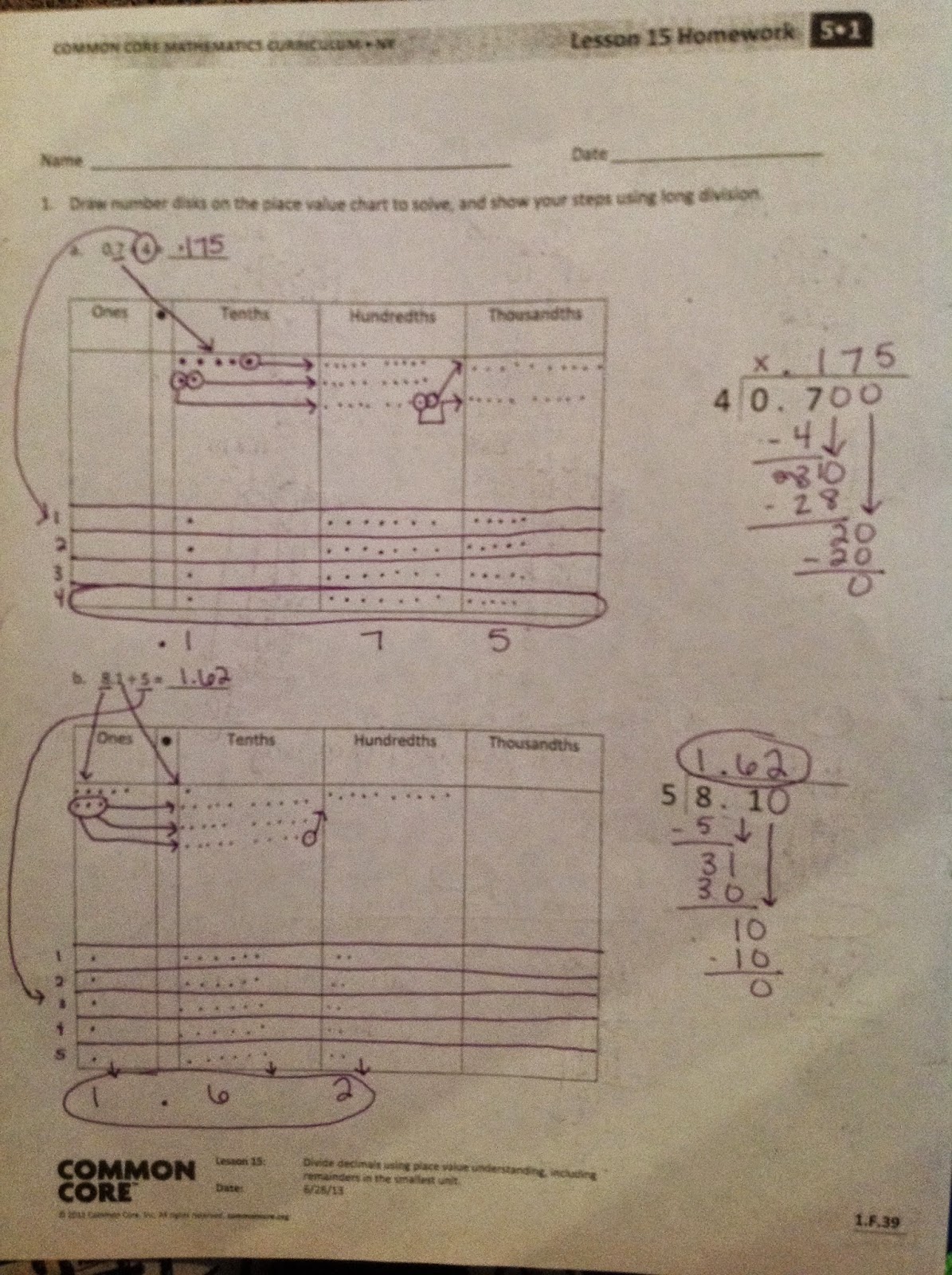
The math for today is continuing with dividing using the place value chart and the standard algorithm. However, we are having "remainders" and rather than writing R and the number, we are sending our remainder number disks to the right, converting them into 10 number disks of the lesser value on the chart. For instance 1 tenth is the same as 10 hundredths. This way, we do not end up with a remainder at the end. When you are doing the problems with the standard algorithm, you add another zero or multiple zeroes to the end of the number that is being divided, until you no longer have a remainder.
Progress reports will be coming out this week! Keep an eye out for your students!
Thanks!
Mrs. C
The students have a new spelling list and will have a test on Friday.
The math for today is continuing with dividing using the place value chart and the standard algorithm. However, we are having "remainders" and rather than writing R and the number, we are sending our remainder number disks to the right, converting them into 10 number disks of the lesser value on the chart. For instance 1 tenth is the same as 10 hundredths. This way, we do not end up with a remainder at the end. When you are doing the problems with the standard algorithm, you add another zero or multiple zeroes to the end of the number that is being divided, until you no longer have a remainder.
Progress reports will be coming out this week! Keep an eye out for your students!
Thanks!
Mrs. C
Friday, September 19, 2014
Friday September 19th
Today's lesson in math built upon yesterdays about division with decimals.
This assignment has the students dividing with number disks on the place value chart along with doing long division/standard algorithm.
I strongly encourage the students to do the division in both ways and check their work. I also told them that it is okay to triple check their work with a calculator. This should only be done after both options have been done.
I have added some arrows or notes on the worksheet to help better understand the process.
*When dividing on the place value chart ALWAYS start with the largest place value.
*If you have extra number disks that cannot be placed in the groups evenly, they move over to the next place value on the chart.
* For instance, on number 1. a. there are 5 disks in the ones place. They cannot be distributed evenly, so we have 2 left over. 2 ones is the same as 20 tenths. So, we move the extra 2 to the tenths spot by drawing 20 number disks.
Have a great weekend!
Mrs. C
Thursday, September 18, 2014
Thursday September 18th
Sorry it is so late! I have been having some technical difficulties!
Spelling: We have our post test tomorrow!
Missing work: I have told the students that all missing work must be turned in by tomorrow. If it is not turned in, it will be a zero in the grade book.
Math: We have done addition, subtraction, multiplication and have now moved on to division.
Encourage your student to use their place value chart and number disks to solve the problems. If they are word problems, have your student circle or underline important information, break apart the problems to see what needs solved, and make sure they have answered all problems.
Another important thing to keep in mind is the actual place value the number is in. It is easy to get in a hurry and mistake tenths, hundredths and thousandths.
Mrs. C
Spelling: We have our post test tomorrow!
Missing work: I have told the students that all missing work must be turned in by tomorrow. If it is not turned in, it will be a zero in the grade book.
Math: We have done addition, subtraction, multiplication and have now moved on to division.
Encourage your student to use their place value chart and number disks to solve the problems. If they are word problems, have your student circle or underline important information, break apart the problems to see what needs solved, and make sure they have answered all problems.
Another important thing to keep in mind is the actual place value the number is in. It is easy to get in a hurry and mistake tenths, hundredths and thousandths.
Mrs. C
Subscribe to:
Posts (Atom)